

Thanks for making THE RIGHT WAY the #1 newsletter for red-pilled patriots around the world.
Get 20% off today to help me share the absolute truth!
President Trump headed to Evian, France for the G-7 conference so I headed to the Italian-French Alps nearby to cover it.
We took the SkyWay Monte Bianco cable car to the top of the Pointe Helbronner — to a summit station so high and awesome that you’re rendered speechless by the sheer vertical plunge in every direction. The SkyWay is the world’s most expensive tram and it shows: the modernist glass and steel base station is like something out of a James Bond movie. At the very top, there’s a cafe where you can sit and watch the snowy winds blow across Mont Blanc to Monte Rosa and the Matterhorn and Gran Paradiso.
But we were practically the only ones in the cafe — since the vast majority of our companions on the cable car were Germans and Italians and Japanese and Swiss and Americans in serious mountain gear who exited the summit station with their climbing ropes and safety helmets to go traverse the glacier heights.
It was awesome and terrifying to watch them pull out their pick axes and step into the white void — and it was slightly crazy to watch so many people casually attempt something so dangerous while we enjoyed coffee and cake from the safety of the glass-cubed cafe. For an hour, we watched a rescue helicopter picking up climbers from the glacier with just a harness and safety rope swinging each human body off the mountain and into the high wind like a twirling kite — and so many thousands of feet above the hard ice.
Americans like to say that they work hard and play hard — but this was something else entirely. It looked to me like the Europeans (at least the ones I saw that day) liked to work casually and then play with death.
This was a paradox. This was a conundrum. The Europeans seemed to be quite laissez-faire during their working hours and then very extreme sports on the weekend. At least it seemed that way to me.
I was trying to understand the Italian mentality. The long hours they will sit in a cafe while sipping one drink — the measured slowness of it. And then they all get into their tiny cars and drive like bank robbers fleeing the scene of the crime.
The Italians drive so very fast and eat so very slow that I started to wonder why most Americans drive fairly slow and eat fairly fast.
We are always telling ourselves and everyone else that we are in a hurry to get back to business. And since we have to pay twice as much for everything (compared to the Italians) then it’s obvious that we are pretending to be dutiful about mere necessity: we’re working hard just to stay alive and solvent.
The Italians, meanwhile, do not seem so concerned about inflation or going bankrupt or losing their healthcare — and they are jumping off mountain cliffs on hang-gliders and setting land-speed records in subcompact cars every weekend to prove it. Perhaps universal basic health care is responsible for turning the Italians into daredevils?
Anyway, that’s my working theory about our very different “rates of speed.”
Let’s talk a bit more about that measured slowness that you see in the Italian cafes. That’s the part that really attracts the American mind initially. After all, Italy is the home of the “slow food” movement — and you might say it’s also the spiritual home of the “slow life” movement too.
This is a compliment once you understand it.
Instead of my usual $7 Starbucks monster latte served in a chain store, I was visiting the local cafes every morning for a cappuchino doppio (double shot) and there was no “to-go option” anywhere. There were no paper cups or drive-through windows either.
In fact, the whole “fast-casual” corporate food chain system that we have in the United States does not exist in Italy. This was annoying at first, and fantastic eventually. We were literally unable to speed through breakfast or lunch or dinner — Italy forced us to slow down and consider every meal.
You want coffee in the morning? We had to stop the car at a cafe, sit down and order coffee, and then wait until the waiter brought us our drinks with saucers and little spoons and organic sugar packets. The price: two euros. I was saving $5 every day on coffee — and coffee is probably my biggest expense after housing.
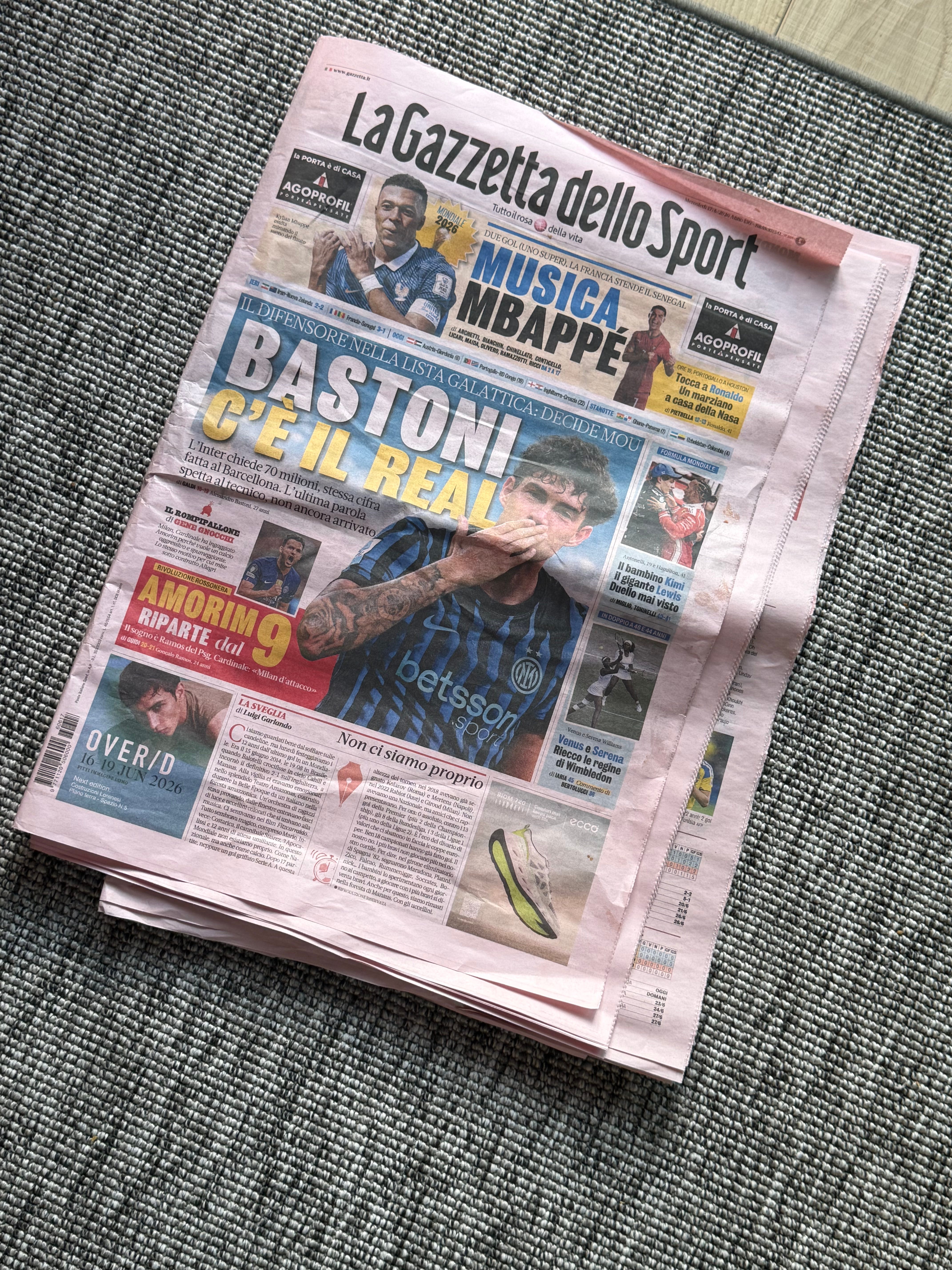
There were Italian newspapers on the bar counter if you wanted to scan the headlines — and all the headlines were about soccer (or more properly, football) with the political news banished to the back pages. In fact, the Italians produce 50 pages on soccer every day for the La Gazzeta dello Sport — and only one page of it was coverage of the G-7 conference.
The price of essentials at the grocery store? Noticeably lower. A loaf of bread was also two euros. Salami, apples, oranges, natural water, sparkling water — much cheaper too. The only items I could find that were more expensive than what I was used to paying in America were watermelons and pencils and gasoline.
Why the pricey watermelons? I have no idea. The pencils? No clue.
As for the gallon of gasoline, it was $10 — and that’s a crazy price to pay but then I started to notice that my rental car was getting 50 miles per gallon. Everybody over here now drives a hybrid car — so you get a tiny engine with an electric battery that’s good for 600 kilometers on a tank of gas.
You don’t have any horsepower in Europe — but you’re an American who’s not going very fast anyway because the streets are so narrow and the Italians are so crazy behind the wheel that you want to slow down in order to live.
In other words, the slow living movement in Italy extends even to automobiles if you’re an American with kids. At least, that’s how I felt every time I got on the autostrada. The Italians, of course, seem to be trying to die on the roads in their tiny cars with no horsepower all around you for some reason — and that’s an impressive national characteristic we noticed in every town and village we visited.
The Italians really like to race. It’s fundamental to their character. They race their cars. They race their bicycles. They race their boats. They probably would race wheelchairs if you gave them the chance. I saw old Italian ladies and old Italian gentlemen on very expensive competition race bicycles all over Italy this summer — we’re talking about people in their late 60s and early 70s wearing the colorful race jerseys and fancy bicycle tights of professional sponsored riders on tour.
It was weird and silly and wonderful. Half the population of Italy seemed to be trying to learn how to bike uphill while being fully dressed as Lance Armstrong. I was merely trying not to accidentally kill them on the insanely narrow mountain roads where they congregated at every blind switchback.
Plenty of these people were not in the kind of shape to be doing what they were doing.
That didn’t matter.
It’s the look that really counts — and the look is very sporty.
Support The Last Fearless Journalist!
“Emerald Robinson is one of the most fearless and accurate reporters in America today.” — Gateway Pundit
“She’s got balls made of titanium.” — Steve Bannon
“The best journalist in America, I think.” — Patrick Byrne
“There are a handful of heroes and heroines right now in history — and Emerald Robinson is one of them.” — Dr. Naomi Wolf
“Well done Emerald — great reporting.” — Lara Logan
Emerald’s election fraud reporting “is an historic and incredibly important thread of information about the stolen elections of 2020 and how a small group of patriots willingly risked damn near everything to save this republic.” — General Mike Flynn
“You were the one who got me to pay closer attention [to the Jeffrey Epstein scandal] a few years ago.” — Rep. Thomas Massie
“Emerald Robinson was the first, and for the longest time, the ONLY one to have me on to talk about my first hand experience with the [Biden] autopen.” — Gabby Cuccia
“Emerald Robinson was ultimately banished because she upset the regime. She was the lone person in the White House press corps who actually challenged the narrative.” —Jordan Schachtel
“Emerald is truly one of the great conservative writers of our times. As funny as Mark Twain and as astute as Steve Bannon.” — Viktor K.
“Some journalists write with pens, she writes with knives.” — Vicchus
“You are the female version of Tucker Carlson. You have been prescient about so many things it’s almost scary.” — F. Lawrence Coleman
“You and Glenn Greenwald are the best in terms of current journalism. You and Lara Logan in terms of fearlessness!” — Mac T.
“When all is said and done, Emerald is going to be hailed as this century’s Edward R. Murrow.” — Don Reed


